 1 km
1 km 









Niko Berdzenishvili Kutaisi State Historical Museum is one of the oldest and important museums in Georgia. Located at 18 Pushkin Street, Kutaisi, it preserves more than 200,000 artifacts representing Georgia’s cultural heritage from the 9th–7th centuries BC to the late medieval period.
Its permanent exhibition is displayed across ten galleries on two floors. The holdings are organized into eleven major collections: Archaeology, Numismatics, Ethnography, Metalwork and Goldsmithing, Painted Icons, Textiles, Manuscripts and Early Printed Books, Military Equipment, Photography, Fine Arts, and the Scientific Library and New History Fund. Its collections include materials from western Georgia, as well as rare Georgian, Roman, Byzantine, and Asian artifacts, ancient manuscripts, royal charters, one of Georgia’s oldest collections of epigraphic monuments, and outstanding examples of traditional craftsmanship, including goldsmithing, metalwork, ceramics, leatherwork, glass, textiles, and woodcarving, reflecting the region’s rich historical and cultural heritage.
A Brief History of the Museum’s Foundation
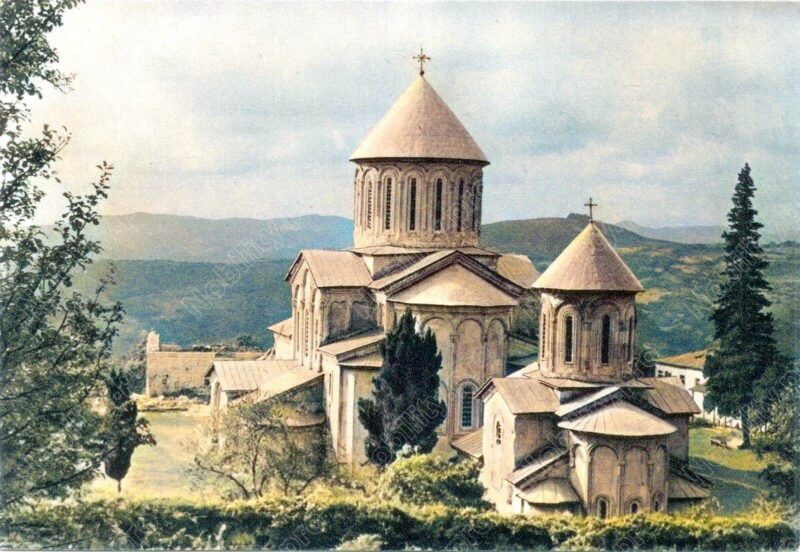
In 1881, participants of the Fifth Archaeological Congress visited Kutaisi and, impressed by the city’s historical monuments, including Gelati Monastery, proposed establishing a museum to preserve the region’s cultural heritage. Although the idea was not realized at the time, it was revived in 1907.
On December 4, 1911, the Historical and Ethnographical Society of Kutaisi was founded at the Kutaisi Gymnasium. Its statutes were approved in 1912, and the creation of the society’s museum department marked the foundation of the Kutaisi Historical Museum. Among its founders were Joseph Otskheli, Simeon Otskheli, Triphon Japaridze, Samson Kipiani, and Konstantine Jorjikia.
From the beginning, the society collected archaeological, historical, and ethnographical materials from across western Georgia with the support of local communities, Georgian noble families, scholars, and students. Kiril Lortkipanidze contributed his personal literary archive and library to the museum, while representatives throughout western Georgia helped collect and preserve historical artifacts.
In December 1922, the museum became an independent institution, and on June 10, 1923, its first public exhibition opened under the leadership of its first director, Triphon Japaridze. During the Soviet anti-religious campaign, Japaridze played a crucial role in preserving the treasures of Gelati Monastery, including valuable icons, manuscripts, and ecclesiastical artifacts, as well as the relics of the Holy Brothers David and Konstantin. He later became a victim of Soviet repressions.
Archaeological expeditions in western Georgia during the 1920s greatly expanded the museum’s collections. In 1924, Peter Chabukiani discovered the Tetramitsa Neolithic settlement near Kutaisi, the first confirmed Neolithic culture site identified in Georgia.
In 1965, the museum was named after the Georgian historian Niko Berdzenishvili. Since the second half of the 20th century, it has continued to develop its collections and scientific research, publishing scholarly works since 1968 and conducting archaeological studies at important sites such as Bagrati Cathedral, Gelati Monastery, and Motsameta Monastery.