 1 km
1 km 
















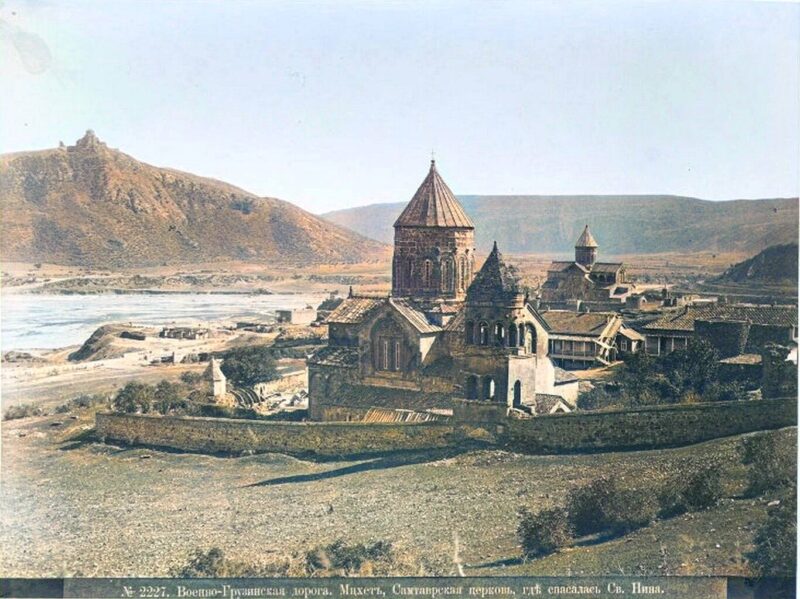
Svetitskhoveli Cathedral – The most important monument of Georgian culture, art and architecture – 54 meter-high Svetitskhoveli stands at the confluence of the Mtkvari and the Aragvi. The history of the temple is inseparable from the history of Georgia. The place of the Svetitskhoveli and the construction of the first temple are related to spreading Christianity in Georgia.
The main entrance gate through the temple wall was built in 1029 by the order of the Catholicos Melchizedek. The gate is a two-storey construction. There are sculptural images of stone bulls in the upper part of the arch of the gate. Starting from the Bronze Age, the bull had been the cult that was spread throughout the whole Georgia and it was the symbol of farming. In the pre-Christian traditions, the bull was sometimes associated with the moon or the sun cult ritual.
According to “Kartlis Tskhovreba” (The Life of Kartli), in the 1st century, the Holy Robe of Christ was brought from Golgotha to Mtskheta by Eliozishvili (Elioz Mtskheteli) and Longinos Karsneli, Jews from Mtskheta who were present at the Crucifixion of the Savior. Svetitskhoveli Cathedral was later erected on the very spot where this sacred relic was hidden. Upon their return, Elioz’s sister, Sidonia, ran out to meet them, snatched the sacred garment from their hands, and pressing it to her chest, fell dead. No human effort could pry the holy relic from her embrace, and therefore, Sidonia was buried together with it in the Royal Garden. Soon, a massive cedar grew over this spot.
Abiathar, a descendant of Eliozishvili, was the first to accept the teachings of Saint Nino and revealed to her which sacred relic was preserved under the cedar. Upon King Mirian’s conversion to Christianity, he ordered a temple to be built over the sacred site of the Holy Robe. The cedar was felled to make seven pillars, but the main one rose into the air and remained immovable. Saint Nino spent the whole night praying, and in the morning, the pillar lit up and descended to its place, and holy myrrh began to flow from it. This miracle gave the cathedral its name — Svetitskhoveli, the “Living Pillar.”
The temple existed till XI c. After uniting Georgia Catholicos-Patriarch of Georgia Melkizedek I trusted architect Arsukidze to construct a new, large cross-domed temple. There is a relief image of the right arm with an architect square tool under the central arch of the cathedral with the inscription on both sides: “The hand of the slave of God Arsukidze. Forgive him.” Since the day of its blessing Svetitskhoveli Cathedral has been the residence of Catholicos Patriarchs of Georgia.
As you enter the temple, the grandiose space opens in front of you. At the entrance, there is a stone Baptismal Font on the right, which must have been of the times of the Baptism of Georgians and it must have been gilded. In the upper parts of the cathedral there were hiding places to escape to during adverse times, also – to hide the temple treasure and libraries in them.
In the western part of the Svetitskhoveli Cathedral there stands Sveti Tskhoveli (“Living Pillar “) in the place of the old main pillar with a self-supporting (neckless) dome and the pyramidal brick roof. The miraculous Pillar was kept there. The Pillar contains fables of the Gospel and scenes depicting the spread of Christianity in Kartli. Christ is represented in the dome area of the pillar. The corners of the arches are decorated with the plants ornaments. The drawing is performed by the painter Grigol Guljavarasshvili under the guidance of Catholicos Nikoloz Amilakhvari in the XVII century (1678-88).
Svetitskhoveli was a final resting place of Georgian kings. According to historical sources, David Ulu, Demetre Tavdadebuli, Giorgi VII, Giorgi VIII, Alexander the Great, Simon I and others must have been buried there. Unfortunately, the graves of Vakhtang Gorgasali, Erekle II and Giorgi XII have only been known to us.