
 13 km
13 km 



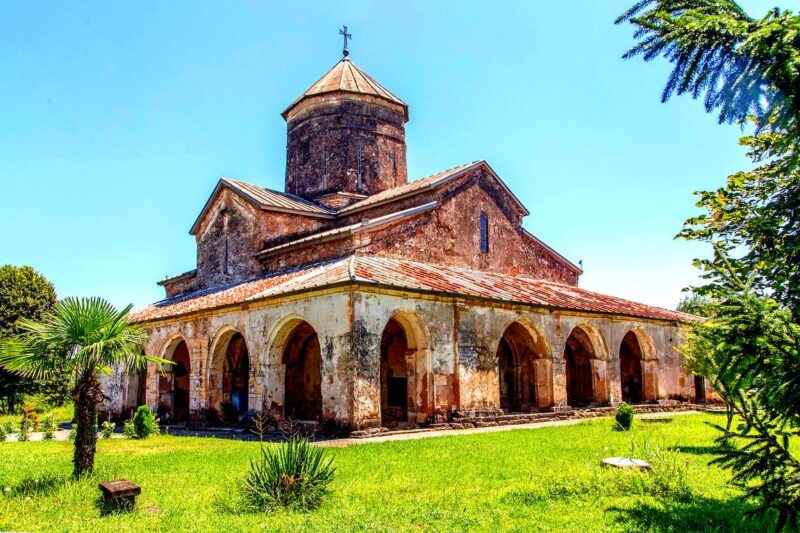



Khobi Monastery – Cathedral of the Dormition of the Most Holy Mother of God – stands on the top of a hillock close to the village. A late-time porch with the bell-tower arranged on its top is the access point to the large yard where the cathedral stands – a rather unique construction for Georgian architecture. It is a cross-shaped building with lower rooms arranged between the arms and with chapels attached from south and west. Absence of the dome in the middle of the cross-shaped church is strange enough as far as its presence would have been more natural for Georgian traditional architecture.
Architecturally, Khobi cathedral is a single-nave construction with the essential elements as follows: major spaces arranged along the main east-west axes coupled with slightly lower transept and rooms at the corners. The church built in the second half of XIII c. has got the exterior adorned with profiled and fretwork facing slabs coupled with rod-like and stair-like frames along the arm edges.
One can hardly find a cloister as rich as the Khobi Cathedral. The Monastery housed the following relics
in the past: a Superior Cross of David the Builder; the cross worn by Queen Тamar, an icon owned by Tamar’s mother Queen Bordokhan; here are the icons citing David Narin, Bedan Dadiani, chief of court officers, Leon II, King of Abkhazia and many others. It is true that we have no data on how and when these relics came here, but it is clear that they were of great significance to t he Georgian people.
According to the church building donor “portraits“, cut on the facing stone slabs, one of wich is currently deposited at the National Museum of Georgia, the very first construction “layer” of the monastery has been built under the patronage of Shergil and Giorgi Dadiani – the members of the ruling house of the historical province of Samegrelo.
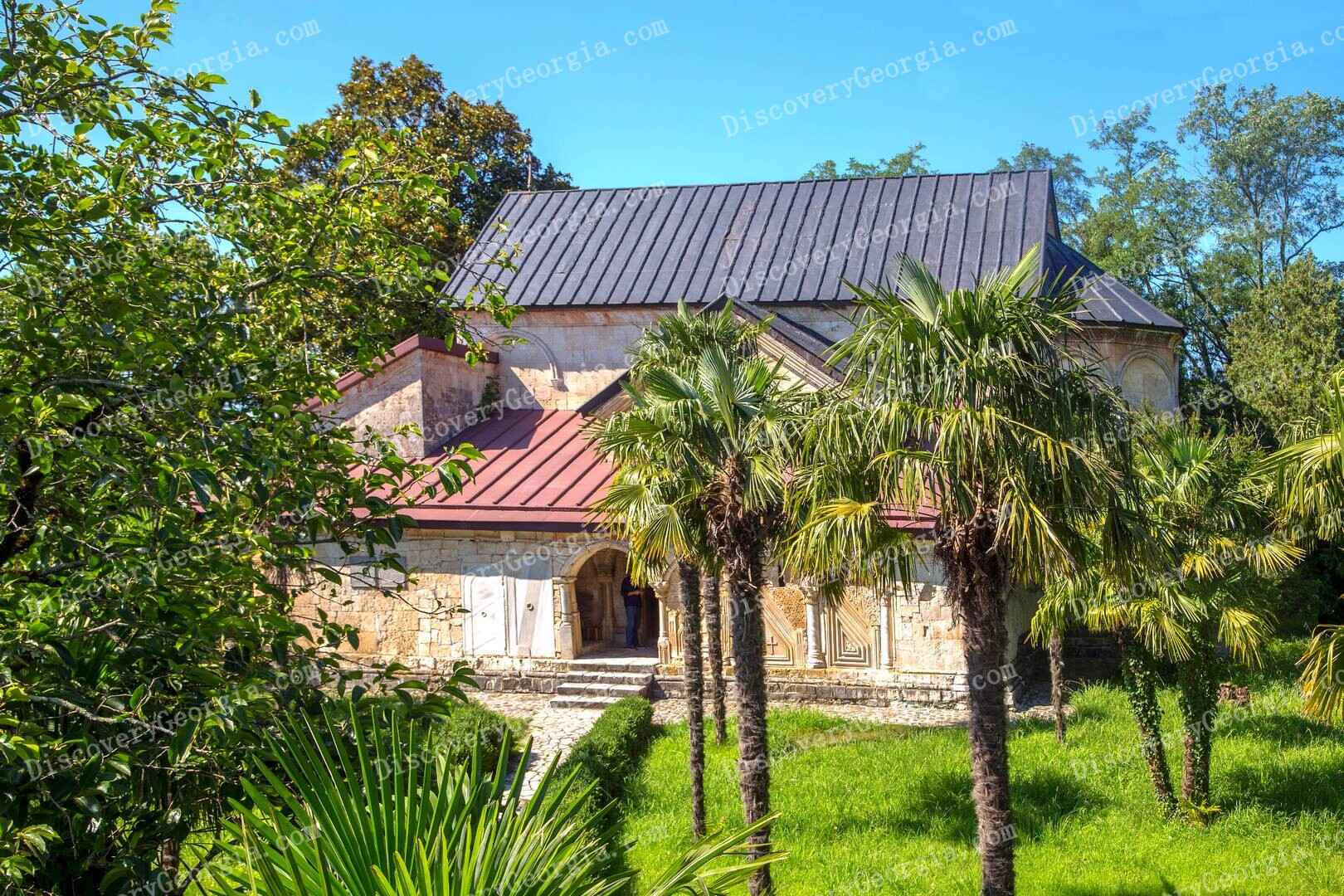
Another representative of the same House, Vamikh – the outstanding political-military figure of the second half of XIVc. arranged his grave in eastern section of the arched porch that had already existed at those times. Marble slabs of the early Byzantine period obtained by this mighty feudal as the spoils of war after his successful expedition to the North Caucasus were used for the adornment of this grave.
Wall paintings of the same period are still preserved in this small chapel, with the portraits of Vamikh Dadiani and his spouse Marekhi. In the course of time internal space of the church has been changed – for instance, initially rooms in the western corner were independent, but later on all of them were incorporated into the main space. A gallery was arranged above those rooms afterwards.
Wall painting preserved in the church interior is mostly rather new-it was performed in XVII c, however there are some sections with relatively early paintings coupled with some other parts re-painted in XVIII c. Frescoes of Levan Dadiani and Nikiphore Cholokhashvili (at various times being an abbot of the Holy Cross Monastery in Jerusalem and Bishop of Khobi Episcopate, famous diplomat and scholar) are preserved there.
Current iconostasis of the church is even of the later times. Many icons, crosses, sacred objects and other church goods had been preserved in Khobi Monastery- some of them being even earlier than the church itself. Currently majority of its collection is exhibited either in Tbilisi State Museum of Art of Georgian National Museum or in Zugdidi Museum.