 8 km
8 km 

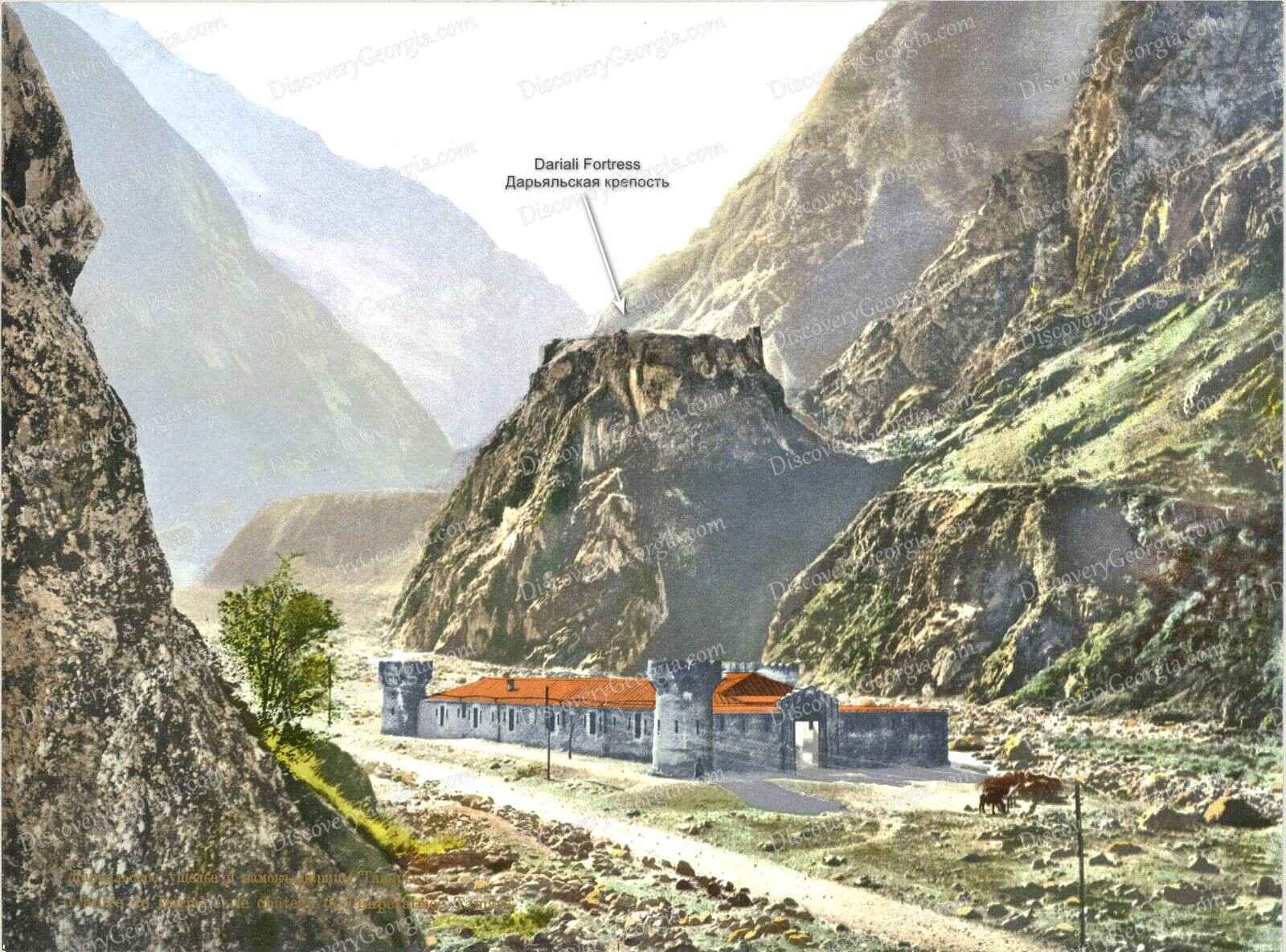
Dariali Fortress is one of the oldest fortresses located in northern Georgia, about which information is found in both Georgian and foreign historical sources. The 1st-century author Pliny mentions a fortress called Kumania at this location. He writes: “The Caucasus Gates are a magnificent creation of nature, formed at this place as a result of a sudden splitting of the mountains; the passage itself is blocked by logs, covered with iron and fastened together; on this side of the gates, on a cliff, stands a fortress called Kumania. The fortress was built in order to restrain countless nomadic tribes.”
According to the view existing in modern scholarship, the fortress of Kumania mentioned by Pliny must have been located on the site of the present-day Dariali Fortress. It is not excluded that the Dariali Fortress represents a restored and repaired Kumania. The basis for such an assumption is the masonry of the southern wall of the preserved Dariali Fortress, which has an archaic appearance. This is also confirmed by artifacts of the ancient period found in this area — ceramics and bronze objects.
The fortress is built in an extremely convenient location. It is self-evident that the ancient road ran along the left bank of the Terek, passed directly through the fortress, and without the permission of the guards passage here was impossible. Traces of this road can apparently still be seen today on the rocky cliff of the left bank of the Terek. The road enters a narrow passage between the fortress and the cliff, which in turn was blocked by a wall.
In early Georgian sources, the fortress is often mentioned as Dariali Fortress and Dariali Gates. For example, the strengthening of the Dariali Gates is attributed by Leonti Mroveli to Mirian, son of Saurmag, who ruled approximately in 189–153 BC. According to the chronicle, Mirian marched his army toward the Dariali Gorge, where the tribes of Chartali and Gligvi (ancestors of the Ingush) lived: “And Mirvan entered Durzuketi,” the Kartlis Tskhovreba narrates, “and devastated Durzuketi and the Chartali. And Mirvan returned to Mtskheta and ruled peacefully and without fear.” From this account it is clearly visible what great strategic importance the northern gates had for the Kingdom of Iberia. Apparently, the protection of the kingdom from nomadic tribes through the fortification of the Dariali Gates was the guarantee of peace for all of Iberia, and above all — a necessary condition for the security of the capital city of Mtskheta.
In the work of the historian Juansher, we find an insertion from another, earlier source, which attributes the strengthening of the Dariali Gates and the construction of the fortress to Vakhtang Gorgasali; it tells how persistently Gorgasali fought against the Alans, defending the gorges of the Aragvi and Darial: “He subdued the Ossetians and the Kipchaks. And he created the Dariali Gates, which we call Dariali (in Persian — “the gates of the Alans”). And he erected high towers on the cliffs and placed them to guard the Georgian highlanders. And the great tribes of the Ossetians and Kipchaks could not pass without the permission of the Georgian king.” It is certainly interesting that every Georgian king began caring for the state with the strengthening of the Dariali Gates and the fortress, which in turn indicates that the northern border of Georgia at that time ran along the Dariali Gorge, and the modern Kazbegi region was fully part of Georgia.
The Dariali Gorge and Dariali Fortress in ancient historical sources are mentioned under the names: Aragvi Gates, Ossetian Gates, Dariali Gates, Khevi Gates, and Caspian Gates. Two defensive structures of this gorge are mentioned: Kumania (Pliny) and Darial, which, as it appears, must be names of one and the same fortress.
From the 19th century onward, the name “Tamara’s Castle” became popular. The Russian poet Mikhail Lermontov was so captivated by the sight of the fortress that he dedicated a poem to it. Because of this, the Dariali Fortress became known as “Tamara’s Castle.” Unfortunately, many mistakenly identify this Tamara with Queen Tamar of Georgia (1184–1213), who has no historical connection to this legend. In reality, the name comes from a version of the folklore tale “The Treacherous Daredjan,” where the name Daredjan was replaced by the name Tamara.